Mesquite, NV · Garage Door Service
Bunkerville homes went up mostly in the early 1990s, a decade before most of Mesquite's stock. That gap changes which springs, openers and tracks fail first.
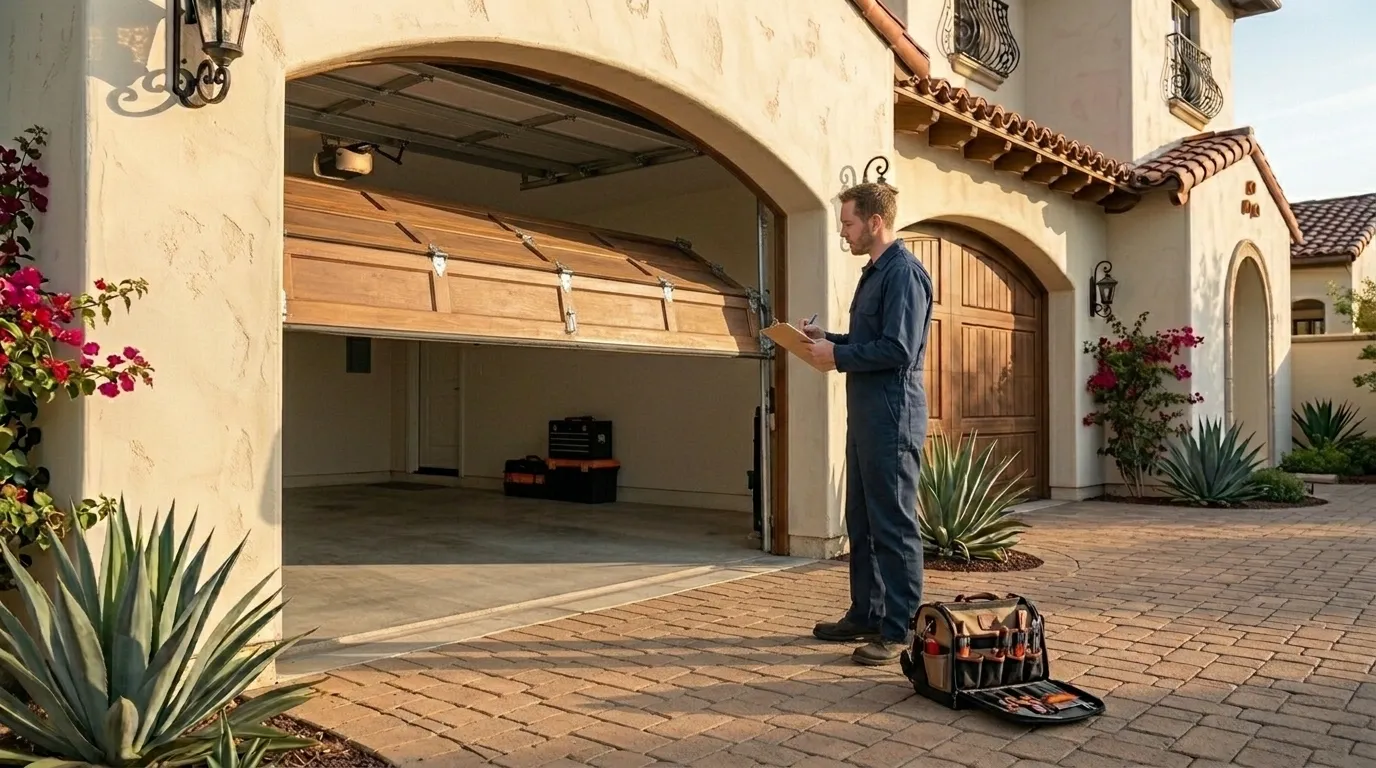
Most of Bunkerville's housing stock dates to around 1991, which puts it noticeably ahead of the 2000s-era doors that make up most of what we see in Mesquite proper. That decade matters more than people think. A door and opener installed in 1991 has had over thirty years to run through springs, cables, rollers and the odd motor gear, and in a lot of houses out here, nobody's touched the original torsion hardware since it went up. We find factory rollers that were never swapped and openers that are original to the house, still running the first drive gear.
Bunkerville sits in a severe-heat climate band, and heat is hard on rubber seals, nylon rollers, and the lubricant inside an aging torsion spring. A spring that's been baking through summers since 1991 doesn't fail gently - it goes at the worst time, usually when the door's been cycled hard on a hot afternoon. Add in that this is a small service area, 230 households total, and you get a lot of houses running the same original-era hardware, aging out on close to the same schedule.
We don't have a branch in Bunkerville. Every job here is a truck out of Mesquite, about 4 miles up the road, so we plan the parts we bring based on what a 1991-era door usually needs, not a guess.
We don't quote a fixed time for Bunkerville jobs because we're not staged there - every visit starts with the 4-mile drive from Mesquite, and what we find once we open the door up depends on how original the hardware still is. A straight spring swap on a door that's otherwise sound is a different job than one where the opener, the track, and the cable drums are all original to a 1991 build.
What we can tell you honestly: older, all-original setups take longer to diagnose, not because the fault is hard to find, but because we're checking every component in the system rather than just the one that failed. If the spring's original, the rollers usually are too, and a roller that's worn out can mask itself as a spring problem or an opener problem until you actually look at it under load. We'd rather spend the extra fifteen minutes checking than come back a second time for something we should have caught on the first visit.
We stock springs, cables, rollers, and hinges sized for standard torsion setups, which covers the bulk of what turns up on doors from the early 1990s. Openers are a different story - if the unit in your garage is original to a 1991 house, the drive gear or logic board that failed may not be something we can pull off the truck. Some of that hardware simply isn't made anymore, and we're honest about it up front rather than promising a same-day fix we can't deliver.
What we can say is that a severe-heat climate wears out seals and rollers faster than a mild one, so those are parts we carry in volume specifically because we expect to need them out this way. If your opener needs a part we don't carry, we'll tell you that on the spot and give you the real timeline instead of a guess.
With a median household income of $149,327 across the service area, a lot of Bunkerville homeowners can afford to replace rather than patch, and that's worth knowing before you decide to DIY a repair on a torsion door. A broken spring is not a safe do-it-yourself job on any door, but it's especially not worth the risk on a system that's been carrying full tension since 1991 - the spring, the winding cones, and the bar have all had thirty-plus years to fatigue, and you can't tell how much life is left just by looking at them.
Where DIY makes sense: lubricating hinges and rollers, tightening loose hardware, clearing the track of debris. Where it doesn't: anything involving the torsion spring, the cable drums, or the opener's internal gearing. If the door's original to the house, treat every component as suspect, not just the one making noise.
On a house this age, the door that groans, jerks, or hesitates partway up is usually not one bad part - it's the accumulated wear of an original system finally catching up with itself. A worn roller adds friction the opener has to fight, the opener works harder than it was built for, and the belt or chain stretches faster because of it. By the time you hear the noise, two or three components are already past their working life.
A door that reverses without hitting anything, or that closes then bounces back up, points to the safety sensors or the torsion spring losing balance - both worth a look before the door drops on something, or someone. Out here, where a lot of hardware is original to 1991, we treat any of these symptoms as a full-system check, not a single-part swap.
We start by testing the door under its own weight, off the opener, to see what the spring and cables are actually doing before the motor masks the problem. On a 230-household area where most of the stock went up around 1991, that step catches a lot of faults that would otherwise get blamed on the opener.
We replace what's failed, not what's merely old, unless the old part is a genuine safety risk - a spring at the end of its cycle life gets swapped regardless of how it looks. We carry the common torsion parts on the truck for the 4-mile run from Mesquite, so most jobs close out in one visit. Where the original opener needs a part we don't stock, we'll say so and give you options rather than stall the job.
It's possible, and worth checking. A lot of Bunkerville houses from that era still have their original torsion springs, rollers, and sometimes the original opener. Thirty-plus years of use in a severe-heat climate puts real wear on all of that, even if nothing has failed yet, so it's worth a look before it fails at an inconvenient time.
No. We run the job out of Mesquite, about 4 miles away, and bring the parts we expect to need based on the age of the door. We don't promise a Bunkerville-specific response time because we're not staged locally.
Depends what's failed. If it's a part we stock, we'll repair it. If it's the drive gear or logic board on a unit that old, replacement parts may not exist anymore, and replacing the whole opener is usually the more honest answer than chasing discontinued parts.
Call now or request a free quote - same-day service on most repairs, upfront written pricing.