Mesquite, NV · Garage Door Service
Garage door repair for Bunkerville, NV homes built around 1991. We cover the 4-mile run from Mesquite for spring, opener, and track fixes on original 1990s-era hardware.
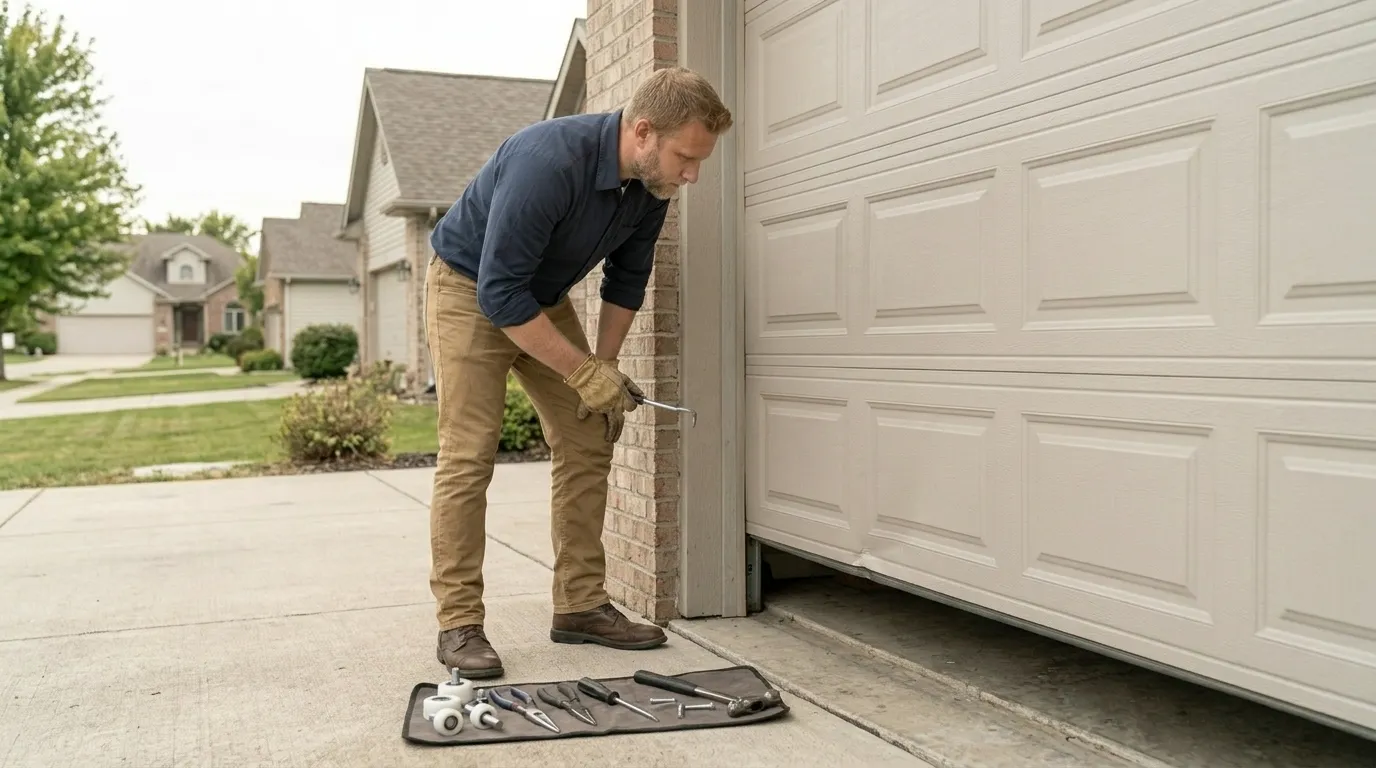
The fault we see most in Bunkerville isn't the same one we see on newer builds closer to Mesquite. Most houses here went up around 1991, a full decade before the newer stock common elsewhere in the service area. That means original torsion springs, original opener units, and original track hardware that's been running for over thirty years without a swap.
That age shows up as fatigue, not sudden failure. Springs lose tension gradually and start letting the door drop the last foot instead of settling. Openers with original gearing strip quietly, so the motor runs but the door doesn't move, or moves and then reverses for no clear reason. None of this is dramatic until the day it is - a spring that's been weakening for years can still let go all at once, and on a double door that's real weight coming down fast.
We also see doors here that were never touched after the original install, which means whoever installed them chose hardware sized for that era's doors. A repair on one of these isn't always a matter of grabbing a part off the truck and bolting it on - sometimes the shaft diameter or the drum size doesn't match what's standard now, and we have to account for that before we start.
Bunkerville sits about four miles out from Mesquite, which is the difference between a same-day fix and a next-day one once parts have to come from the truck stock in town. For a standard call - broken spring, worn rollers, a cable off its drum - the drive doesn't change much about how the job runs once we're there.
Where it matters is on anything that needs a part we don't carry. If your opener is an original unit from the early '90s and the circuit board or logic panel has failed outright, we may not have that exact board on the truck, and getting it means either sourcing a compatible replacement or, more often, recommending a new opener instead of chasing parts for one that's over three decades old. We'll tell you straight when that's the better call rather than stringing out a repair on borrowed time.
With 230 households spread through this pocket of the service area, and 186 of them owner-occupied, most of the doors we see here are original to the build. That means the springs, rollers, and cable we carry are sized for that era of door - standard torsion springs for single and double doors, ball-bearing and nylon rollers, galvanized lift cable, and standard hinges and end bearing plates.
Where we run into trouble is opener electronics. A wall control or receiver from the original install sometimes uses a frequency or wiring setup that current openers don't replicate exactly, so a straight swap-in repair isn't always possible - we may need to replace the full opener unit rather than just the failed part. We're upfront about that before we start any job, not after we've already opened up the housing.
A homeowner can safely handle a few things on one of these older doors: lubricating hinges and rollers, tightening loose bolts on the track brackets, clearing debris from the bottom seal. What you should not touch is the torsion spring. It's under enough stored tension to break a hand or worse, and on a door that's been running unchanged since 1991, that spring has had thirty-plus years to develop a weak point you can't see from the outside.
Opener issues are a mixed bag. If the remote just needs new batteries or reprogramming, that's a five-minute job with no risk. If the opener is running but grinding, slipping, or reversing on its own, that's usually a gear or capacitor problem, and diagnosing which one it is without pulling the housing apart is guesswork. The median household income here runs $149,327, which is why we still see a fair number of owners paying to fix an old opener rather than replace it outright - it's often the right economic call, but it only makes sense once someone's actually looked at what failed.
Bunkerville's summer heat load falls in the severe band, and that's what cooks opener circuit boards and dries out spring lubricant faster than it should. The symptom we get called out for most in the hot months is a door that runs partway up, stalls, and reverses - that's the opener's force sensor tripping because the door is binding on dried-out track or because the capacitor that gives the motor its starting torque has weakened under sustained heat.
The other common one is a spring that's clearly lost tension: the door feels heavier lifting by hand, or it slams the last few inches on the way down instead of settling. On a build this age, that's not a surprise - it's closer to due. Heat cycling a spring for thirty summers wears the coil differently than the same spring would wear in a milder climate, and it usually shows up as this exact symptom rather than a clean, sudden snap.
For a spring replacement on an original 1991-era door, we match the new spring to the door's actual weight and drum size rather than assuming a standard size fits, since some of these older doors were built a bit heavier than what's common now. We back off the old spring's tension safely, swap it, and set the new one to balance so the door lifts and holds at any point without the opener straining.
For an opener that's failing under heat, we test the capacitor and the logic board separately before recommending a fix. If it's the capacitor, that's usually a straightforward swap. If the board itself has degraded, we'll walk you through whether a new opener makes more sense than chasing a part for a thirty-year-old unit - often it does, and we'd rather tell you that up front than sell you a patch job. Every repair gets checked with a full open-close cycle before we call it done.
The heat here falls in a severe band, and it's hard on both spring lubricant and opener electronics. Lubricant dries out faster, springs lose tension a bit quicker, and opener capacitors that give the motor its starting torque weaken under sustained high temperatures. That combination is why summer is when a lot of these original-hardware doors finally show a symptom.
No. We run out of Mesquite, about four miles away. For most standard repairs - springs, rollers, cable, hinges - that distance doesn't change the job once we're on site. It only becomes a factor if a part isn't in truck stock and has to be sourced separately.
Sometimes. If it's a capacitor or a simple mechanical part, yes, that's usually a straightforward fix. If the logic board or receiver has failed, compatible parts for a unit that old aren't always available, and we'll often recommend a new opener instead of chasing a part that may not exist anymore.
We'd tell you not to. A torsion spring on a residential door holds enough stored tension to cause a serious injury if it releases wrong, and on a door running original hardware since 1991, that spring has had decades to develop a weak point that isn't visible from outside. This is one job worth paying for.
Call now or request a free quote - same-day service on most repairs, upfront written pricing.